Download Ebook Inviting Disaster: Lessons From the Edge of Technology, by James R. Chiles
Just how can? Do you believe that you do not require enough time to go with purchasing publication Inviting Disaster: Lessons From The Edge Of Technology, By James R. Chiles Don't bother! Simply rest on your seat. Open your kitchen appliance or computer as well as be online. You could open up or check out the link download that we offered to obtain this Inviting Disaster: Lessons From The Edge Of Technology, By James R. Chiles By through this, you can obtain the on-line e-book Inviting Disaster: Lessons From The Edge Of Technology, By James R. Chiles Reviewing the book Inviting Disaster: Lessons From The Edge Of Technology, By James R. Chiles by online can be really done effortlessly by saving it in your computer system as well as device. So, you could continue whenever you have free time.
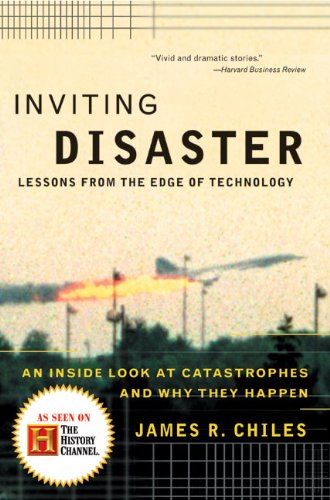
Inviting Disaster: Lessons From the Edge of Technology, by James R. Chiles

Download Ebook Inviting Disaster: Lessons From the Edge of Technology, by James R. Chiles
Is Inviting Disaster: Lessons From The Edge Of Technology, By James R. Chiles publication your favourite reading? Is fictions? Exactly how's concerning record? Or is the very best seller novel your option to satisfy your extra time? Or even the politic or spiritual books are you looking for currently? Below we go we provide Inviting Disaster: Lessons From The Edge Of Technology, By James R. Chiles book collections that you require. Great deals of varieties of publications from numerous industries are provided. From fictions to science and spiritual can be looked as well as figured out right here. You may not worry not to discover your referred book to check out. This Inviting Disaster: Lessons From The Edge Of Technology, By James R. Chiles is among them.
Checking out publication Inviting Disaster: Lessons From The Edge Of Technology, By James R. Chiles, nowadays, will not require you to always acquire in the establishment off-line. There is an excellent location to purchase guide Inviting Disaster: Lessons From The Edge Of Technology, By James R. Chiles by on-line. This site is the very best website with great deals varieties of book collections. As this Inviting Disaster: Lessons From The Edge Of Technology, By James R. Chiles will certainly be in this publication, all publications that you require will be right here, too. Simply hunt for the name or title of guide Inviting Disaster: Lessons From The Edge Of Technology, By James R. Chiles You could find exactly what you are looking for.
So, also you require obligation from the firm, you could not be puzzled any more due to the fact that books Inviting Disaster: Lessons From The Edge Of Technology, By James R. Chiles will certainly constantly aid you. If this Inviting Disaster: Lessons From The Edge Of Technology, By James R. Chiles is your best companion today to cover your job or job, you can as quickly as feasible get this publication. How? As we have told previously, simply go to the web link that we offer right here. The conclusion is not just the book Inviting Disaster: Lessons From The Edge Of Technology, By James R. Chiles that you search for; it is how you will certainly get lots of books to sustain your skill and also capacity to have great performance.
We will reveal you the very best as well as most convenient means to obtain book Inviting Disaster: Lessons From The Edge Of Technology, By James R. Chiles in this world. Bunches of compilations that will assist your task will be right here. It will certainly make you feel so ideal to be part of this site. Becoming the participant to constantly see just what up-to-date from this book Inviting Disaster: Lessons From The Edge Of Technology, By James R. Chiles website will make you really feel right to search for guides. So, just now, and here, get this Inviting Disaster: Lessons From The Edge Of Technology, By James R. Chiles to download and also wait for your priceless worthwhile.
Combining captivating storytelling with eye-opening findings, Inviting Disaster delves inside some of history's worst catastrophes in order to show how increasingly "smart" systems leave us wide open to human tragedy.
Weaving a dramatic narrative that explains how breakdowns in these systems result in such disasters as the chain reaction crash of the Air France Concorde to the meltdown at the Chernobyl Nuclear Power Station, Chiles vividly demonstrates how the battle between man and machine may be escalating beyond manageable limits -- and why we all have a stake in its outcome.
Included in this edition is a special introduction providing a behind-the-scenes look at the World Trade Center catastrophe. Combining firsthand accounts of employees' escapes with an in-depth look at the structural reasons behind the towers' collapse, Chiles addresses the question, Were the towers "two tall heroes" or structures with a fatal flaw?
- Sales Rank: #70362 in Books
- Published on: 2002-08-20
- Released on: 2002-08-20
- Original language: English
- Number of items: 1
- Dimensions: 8.00" h x .83" w x 5.31" l, .59 pounds
- Binding: Paperback
- 338 pages
Amazon.com Review
Inviting Disaster, by technology and history writer James R. Chiles, is an unusual book: it appeals to the macabre desires that keep us riveted to highway accidents, while knowledgeably discoursing on the often preventable mistakes that caused them. At its heart are colorful stories behind more than 50 of the most infamous catastrophes that periodically chilled the advance of the industrial age. There are both those well remembered (the 1986 Challenger explosion, for example) and those now largely forgotten (a 1937 gas explosion at a Texas school that killed 298). But along with lively depictions of these deadly devastations and white-knuckle calamities--the U.S. battleship Maine, Apollo 13, and Three Mile Island among them--Chiles offers an informed analysis of the unfortunate chain of events that brought them about. And by grouping like incidents to show how fatal "system fractures" eventually developed through a combination of human error and mechanical malfunction, he also suggests how we might sidestep such tragedies in the future. In so, doing he fashions these spectacular accounts of failed planes, trains, ships, bridges, dams, factories, and other conveyances and facilities into a cautionary tale about technological progress. --Howard Rothman
From Publishers Weekly
Despite the specter of the Titanic, the oil rig Ocean Ranger was called "unsinkable" until one fateful night in the North Atlantic in 1982. Failing to anticipate that the vessel could list significantly to one side, its builders left open some five-foot-long holes on top of its corner supports, which filled with water during a terrible storm and led to the deaths of all 84 crew members. Chiles treats readers to a laundry list of such disasters from Bhopal to Chernobyl that arose from mistakes, panic or hubris. The result is a parade of dramatic stories about people who are simply unable to think in critical situations: "imagine having to take the most difficult final exam of your life while somebody is lobbing tear-gas grenades at you... when you are also suffering a major migraine headache and violent food poisoning." In some cases, he suggests proactive measures (e.g., when on a plane, note the number the rows to the exit, in case there's a snafu involving blinding smoke). In a book that is much more than a litany of disaster and tips on survival, Chiles also offers fascinating, detailed analyses of "system fractures" chains of events yielding catastrophes. Despite the depressing subject matter, the book is ultimately hopeful, recounting numerous acts of foresight or bravery in the face of bureaucratic opposition that saved many lives. (Aug. 31)
Copyright 2001 Reed Business Information, Inc.
From Library Journal
Anyone who's been caught in a traffic jam caused by an accident can attest to what seems to be a universal fascination with disaster. While an engaging topic does not guarantee a good book, this volume on the conflicts between machines and humans is accessible and free of excessive technical jargon. This is not a Luddite's call for a return to the days before complicated technology but a careful examination of various disasters such as Chernobyl, Three Mile Island, the Space Shuttle, and an assortment of industrial and airline accidents and how they might have been prevented. While not all accidents can be avoided, Chiles shows how a large number of them could have been. Chiles contributes regularly to Smithsonian magazine, Audubon, and Air & Space, and the level and style of writing exhibited in these publications is maintained in this text. Highly recommended for academic and public libraries. James Olson, Northeastern Illinois Univ. Lib., Chicago
Copyright 2001 Reed Business Information, Inc.
Most helpful customer reviews
0 of 0 people found the following review helpful.
Very good book
By Lynn B Reed
I've read this book multiple times. I have some minor quibbles with some of the story structures and I think a better editor could have tightened it up, but overall, this is a really great read if you are interested in the whys and hows of catastrophic events. The lessons learned and discussions of testing and team communication really can be applied not just to high stakes or dangerous jobs, but many day to day work processes in construction, IT, banking; any job where changes are installed that impact customers or processes used by people on a regular basis. It can almost make you anxious to consider times in your job where maybe a more robust testing process could have benefited the product and reduced risk.
0 of 0 people found the following review helpful.
Great overview to understand system failures using well-known cases.
By Timothy P. Lyons
I bought this book as an additional resource for an MBA Course on Organizational Theory but actually enjoyed the read!
Chernobyl, Three Mile Island, Challenger, 9/11, and other well-known cases of systematic failure are documented in this book. Using twenty years of experience James R. Chiles chronicles the systematic breakdown of these disasters rather than sudden failures. Using chronological evidence gathered he is able to show the systematic breakdown of events leading up to the failure we all know as a sudden occurrence. Who knew that so many things had to go wrong in order for some failures to occur?
This book is not a comprehensive chronology of these events but rather a brief overview of each. The author bounces back and forth between several similar stories within a chapter (often spanning over a century between stories) and can get confusing at times, but a careful re-read of the page and you'll understand the connection he's making. Inviting Disaster is a great starting point to understanding systematic failures, and is a great launching point for additional research.
0 of 0 people found the following review helpful.
An inside look at the psychology of human / machine interaction at the worst possible moments.
By Ron G
Chiles presents an inside view in chilling detail on technological disasters and the chain of events immediately preceding them. Even more compelling is not the technical details presented of said disasters, instead the fascinating study of the psychological phenomena as the human mind comes up against an uncompromising set of events that lead to technological catastrophes. As humans we are definitely at the mercy of misinformation, especially when we live in world where we are regularly put in charge of systems that we have no intimate knowledge of.
Chiles presents conclusive and detailed evidence on how our natural tendency to over-estimate our abilities (the Dunning Kruger Effect - Page 131) causes many of us to fail, including groups of us acting in unison. The most interesting stories in this book are not the ones that offer in depth analysis on the actual catastrophes, but instead, the untold stories of those of us who refused to yield to uncertainty and mediocrity, such as the highly touted US Navy Commander Hyman G. Rickover, who fortunately for us was in charge of the US Navy Nuclear Powered Submarine Programs. There are other examples, such as captain Bryce McCormick who foresaw the obvious possibility of complete failure in the DC-10 design in 1970, only to experience it first hand in 1972. His heroic actions are unparalleled today, and there is no doubt McCormick as well as our modern day aviation hero "Cap'n Sully" are in a group of a few elite individuals singled out in history, that through sheer intuition, logic, and self-discipline were able to overcome seemingly impossible situations. They all seemed to have had a deep and clear mental understanding of not only the machine itself but were also able to receive accurate information on the actual operating state of the machine in which they were in control during the crises, allowing them to formulate a plan ("satisficing") that saved countless lives.
Other highly interesting topics discussed in the book: the phenomenon of "Vu Jade" (Page 56), "Satisficing" (page 61), "Normalization of Deviance" (page 67), and finally "Workplace Heuristics" (page 135).
The topics presented especially on Heuristics come frighteningly close to the research of Bruce Schneier on terrorism and "Security Theatre".
"Watching out for signs of known problems is good, but as systems get bigger and more complex we have to remember that our Achilles has many heels, so to speak. Some of the problems that arise will never have come up before, so the simple hindsight of heuristics can't save us." -- James R. Chiles
Inviting Disaster: Lessons From the Edge of Technology, by James R. Chiles PDF
Inviting Disaster: Lessons From the Edge of Technology, by James R. Chiles EPub
Inviting Disaster: Lessons From the Edge of Technology, by James R. Chiles Doc
Inviting Disaster: Lessons From the Edge of Technology, by James R. Chiles iBooks
Inviting Disaster: Lessons From the Edge of Technology, by James R. Chiles rtf
Inviting Disaster: Lessons From the Edge of Technology, by James R. Chiles Mobipocket
Inviting Disaster: Lessons From the Edge of Technology, by James R. Chiles Kindle

Tidak ada komentar:
Posting Komentar