Ebook Download 1939: The Alliance That Never Was and the Coming of World War II, by Michael Jabara Carley
Make use of the advanced modern technology that human develops today to locate guide 1939: The Alliance That Never Was And The Coming Of World War II, By Michael Jabara Carley easily. Yet first, we will ask you, just how much do you enjoy to read a book 1939: The Alliance That Never Was And The Coming Of World War II, By Michael Jabara Carley Does it constantly until finish? Wherefore does that book read? Well, if you really enjoy reading, attempt to read the 1939: The Alliance That Never Was And The Coming Of World War II, By Michael Jabara Carley as one of your reading compilation. If you only reviewed the book based on need at the time and unfinished, you need to aim to such as reading 1939: The Alliance That Never Was And The Coming Of World War II, By Michael Jabara Carley first.
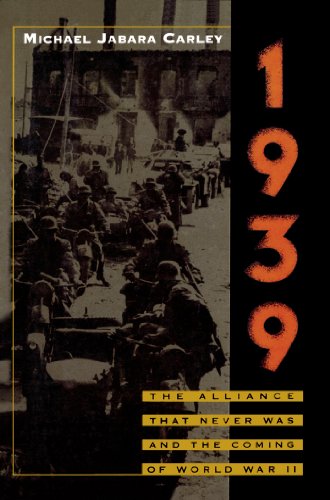
1939: The Alliance That Never Was and the Coming of World War II, by Michael Jabara Carley

Ebook Download 1939: The Alliance That Never Was and the Coming of World War II, by Michael Jabara Carley
1939: The Alliance That Never Was And The Coming Of World War II, By Michael Jabara Carley. Join with us to be participant below. This is the website that will certainly provide you ease of looking book 1939: The Alliance That Never Was And The Coming Of World War II, By Michael Jabara Carley to check out. This is not as the other site; the books will remain in the kinds of soft documents. What benefits of you to be member of this site? Get hundred compilations of book link to download and install and obtain always upgraded book every day. As one of the books we will certainly provide to you currently is the 1939: The Alliance That Never Was And The Coming Of World War II, By Michael Jabara Carley that comes with an extremely completely satisfied principle.
As recognized, lots of individuals state that e-books are the custom windows for the globe. It does not imply that acquiring e-book 1939: The Alliance That Never Was And The Coming Of World War II, By Michael Jabara Carley will certainly indicate that you can buy this world. Merely for joke! Reviewing a publication 1939: The Alliance That Never Was And The Coming Of World War II, By Michael Jabara Carley will opened up an individual to assume much better, to maintain smile, to amuse themselves, and to encourage the understanding. Every publication additionally has their unique to affect the reader. Have you understood why you review this 1939: The Alliance That Never Was And The Coming Of World War II, By Michael Jabara Carley for?
Well, still perplexed of ways to get this book 1939: The Alliance That Never Was And The Coming Of World War II, By Michael Jabara Carley here without going outside? Simply connect your computer or gizmo to the internet as well as start downloading 1939: The Alliance That Never Was And The Coming Of World War II, By Michael Jabara Carley Where? This web page will certainly reveal you the web link page to download 1939: The Alliance That Never Was And The Coming Of World War II, By Michael Jabara Carley You never ever fret, your favourite book will be sooner your own now. It will be considerably less complicated to appreciate checking out 1939: The Alliance That Never Was And The Coming Of World War II, By Michael Jabara Carley by on-line or obtaining the soft documents on your kitchen appliance. It will despite that you are as well as what you are. This publication 1939: The Alliance That Never Was And The Coming Of World War II, By Michael Jabara Carley is created for public and also you are among them which could appreciate reading of this publication 1939: The Alliance That Never Was And The Coming Of World War II, By Michael Jabara Carley
Spending the leisure by checking out 1939: The Alliance That Never Was And The Coming Of World War II, By Michael Jabara Carley can provide such fantastic encounter even you are only sitting on your chair in the office or in your bed. It will certainly not curse your time. This 1939: The Alliance That Never Was And The Coming Of World War II, By Michael Jabara Carley will certainly lead you to have more priceless time while taking rest. It is really enjoyable when at the midday, with a mug of coffee or tea as well as a book 1939: The Alliance That Never Was And The Coming Of World War II, By Michael Jabara Carley in your gizmo or computer monitor. By taking pleasure in the views around, right here you can begin checking out.
At a crucial point in the twentieth century, as Nazi Germany prepared for war, negotiations between Britain, France, and the Soviet Union became the last chance to halt Hitler’s aggression. Incredibly, the French and British governments dallied, talks failed, and in August 1939 the Soviet Union signed a nonaggression pact with Germany. Michael Carley’s gripping account of these negotiations is not a pretty story. It is about the failures of appeasement and collective security in Europe. It is about moral depravity and blindness, about villains and cowards, and about heroes who stood against the intellectual and popular tides of their time. Some died for their beliefs, others labored in obscurity and have been nearly forgotten. In 1939 they sought to make the Grand Alliance that never was between France, Britain, and the Soviet Union. This story of their efforts is background to the wartime alliance created in 1941 without France but with the United States in order to defeat a demonic enemy. 1939 is based upon Mr. Carley’s longtime research on the period, including work in French, British, and newly opened Soviet archives. He challenges prevailing interpretations of the origins of World War II by situating 1939 at the end of the early cold war between the Soviet Union, France, and Britain, and by showing how anti-communism was the major cause of the failure to form an alliance against Hitler. 1939 was published on September 1, the sixtieth anniversary of the Nazi invasion of Poland and the start of the war.
- Sales Rank: #1942337 in eBooks
- Published on: 2009-02-16
- Released on: 2013-03-14
- Format: Kindle eBook
Amazon.com Review
Any book named after that most fateful of years, 1939, is sure to tell a tragic tale. As Michael Jabara Carley writes in the opening pages of this volume, "This is not a pretty story. It is about appeasement and the failures of collective security in Europe against Nazi aggression. It is about moral depravity and blindness, about villains and cowards." Carley offers a provocative thesis: anticommunist passions in England and France prevented these countries from forming an antifascist alliance with the Soviet Union that might have headed off the bloodiest conflict in human history. This is not a totally original idea, but Carley makes a forceful case that just a few years ago was an especially tough sell: "Cold war ideology tended to overshadow Anglo-French culpability and responsibility for the path to war in 1939." In other words, the anticommunist sentiments that made it so difficult to deal with the Soviet Union during the 1930s also made it nearly impossible during the cold war to blame anticommunism for what went wrong. Carley's tale is not entirely bleak; he devotes a fair amount of attention to "a motley, imperfect group of heroes" who warned about the rise of Nazi power and urged a joint strategy with the Soviets to contain Germany. One of these Cassandras was Winston Churchill, but others have been nearly forgotten. Carley revives them on these pages in a thought-provoking--and certainly controversial--book that takes a fresh look at an old topic. --John J. Miller
From Booklist
For decades after the start of World War II, appeasement was a byword for spineless surrender by Britain and France to Hitler's demands. In recent years, revisionist historians have tended to see a more complicated (or balanced) picture, stressing Anglo-French hopes for buying time and acknowledging their legitimate fears regarding Soviet designs in central Europe. Carley is a diplomatic historian who has mined newly accessible Soviet archives in order to present a counter-revisionist thesis. He asserts that reflexive and extreme anti-Communist paranoia on the part of British and French politicians and diplomats prevented a very achievable alliance against Hitler. As a result, a justifiably frustrated Stalin signed the Non-Aggression Pact with Hitler as a means for self-preservation. Carley clearly has an axe to grind and ignores inconvenient factors, including Stalin's own paranoia and the Soviet desire for ideological expansion westward. Still, his utilization of new sources is quite revealing, and his provocative, if slanted, argument is certainly a useful contribution to an ongoing debate among scholars. Jay Freeman
From Kirkus Reviews
A richly detailed history of the failure of British, French, and Soviet political leaders to form the alliance that could have forestalled Hitler's aggression. After a glance backward at Europe in the mid-1930s, Carley (Revolution and Intervention: The French Government and the Russian Civil War, 19171919, 1983) proceeds through the pivotal year 1939, examining the diplomatic strategies employed by the great European military powers as the clouds of world war darkened. The book benefits from Carley's splendid research: he has read the published memoirs of all of the principals involved, as well as their public and private correspondence, and has enjoyed access to the vast archives of unpublished diplomatic exchanges, notes, and reports, much of which has become available only recently to scholars. These documents support Carley's principal thesisthat the French and British feared Hitler, but because they feared the Soviets and Communism more, they adopted the policies of ``appeasement'' that emboldened Hitler; the Soviets, in turn, distrusted the French and the British and therefore signed with the Nazis in late 1939 the mutual nonaggression agreement that sentenced western Europe to years of death and destruction. The book is somewhat flawed by the uneven texture of the prose. Among the myriad quotations Carley's voice is sometimes lost. And most ineffective and feckless are his numerous attempts to enliven his serious text with aw-shucks informalities (e.g., ``the Germans had come a-courtin' '' and coarse slang (at one point he discards his scholarly persona to refer to Molotov, a Soviet diplomat, as ``a ruthless, cold-blooded son of a bitch''). What Carley does best is spotlight the unknown ``heroes'' (his word) of the perioddiplomats like Maksim Litvinov, Ivan Maiskii, Sir Robert Vansittart, R.A. Butler, and Sir Stafford Cripps, who recognized early on that Hitler was the greatest danger to Europe, but, like the better-known Winston Churchill, failed to convince their dilatory governments to act. A heavily documented and dense narrative whose primary appeal is to scholars and diplomatic historians. (2 maps, not seen) -- Copyright ©1999, Kirkus Associates, LP. All rights reserved.
Most helpful customer reviews
2 of 2 people found the following review helpful.
A keystone cold war myth of a Nazi-Soviet "alliance" taken apart piece by piece
By Hatuxka
The eventuality of the Soviet-German nonaggression treaty was not at all due to being induced into a state of "paranoia" as another reviewer asserts, it was pure rationality. In fact, the book shows in exhaustive detail just how far the Soviet Government was willing to go in being patient in their pursuit of leading or letting events lead the western powers to ending their self-destructive maneuverings away from a collective security alliance that might have saved their countries and scores of millions of lives in the world altogether. No one can read this book, so excellently documented in its detailing of the moral and political failings of the political elites of Britain, France and Poland without understanding that the western mythology about an "Alliance" between the USSR and Hitlers Germany was in fact a rational final attempt by the USSR to stave off and buy time to prepare for the eventual onslaught that came. Western versions about the treaty are merely attempts to cover up how the west caused their own destruction that only the Soviet Union eventually prevented from being total permanent and total. Carley detracts from the value of his narrative by engaging in outdated coldwar orthodoxies about what he calls the "Stalinist purges". The book was published in 1999, so uncritically repeating that vague term was incongruous to the critical examination he applies to the myth of a Hitler-Stalin "alliance". Others have demolished the cold war orthodoxies that there were "blood purges BY Stalin. There were in fact conspiracies with Germany intelligence by rogue wreckers to eliminate party members to spread terror and provoke an uprising against the Soviet Govt that failed and the perps were caught, confessed and were sentenced to death.
29 of 32 people found the following review helpful.
Exposing the Cold War mentality of the 1930s
By alvin Finkel
Michael Carley's 1939: The Alliance That Never Was demolishes the Cold War-inspired revisionism regarding the diplomacy that led to World War 2. From the Cold War perspective, Stalin, the left-wing dictator, betrayed the Western democracies who were wooing him, to form a dictators' pact with Hitler, the right-wing dictator. This allowed Hitler to invade Poland, giving the Soviets the chance to steal eastern Poland, a forewarning of how they would behave after World War 2 once the Nazis were beaten.
Wrong in every respect, argues Carley. The Soviets had been pressing for a front with the democracies to prevent Nazi rearmament and aggression since 1934. They still wanted this desperately in 1939, but after Munich, they did not think they would get it. Fanatic anti-communism on the part of most of the leadership of Britain and an important section of the French political class made such an alliance seem unlikely. Indeed the Western democracies appeared to prefer Nazi Germany to Communist Russia. While the Soviet Commissar of Foreign Affairs, Maxim Litvinov, worked tirelessly to press for collective security, and the Soviet Ambassador to London, Ivan Maiski, had an important network of friends in high places in Britain who trusted Soviet initiatives, the Soviet plans were always blocked by the "men of Munich." Led by Neville Chamberlain himself, they included key Cabinet members, members of the Foreign Affairs ministry, and the military. These men were impervious to pleas from Maiski, and from Winston Churchill, and Robert Vansittart for an alliance with the Soviets against the Nazis.
Carley's book is the result of painstaking research in the foreign affairs documents of all the principal players. Particularly important here is his work in the archives of the old Soviet Union that began to open a variety of once-closed documents in the era of glasnost.
While this book focuses almost exclusively on the events of 1939, it reinforces the views expressed in Clement Leibovitz and Alvin Finkel, In Our Time: The Chamberlain-Hitler Collusion, that in the years leading up to World War 2, the leaders of the Western democracies deliberately tried to build up Hitler's power in the hope that he would take on the hated Soviets. He could have all of eastern and central Europe as a reward if he could keep his hands off Britain and France, their empires, and their spheres of influence. Only when it became clear that Hitler would not do these things, did the Western countries reluctantly decide to fight him.
13 of 17 people found the following review helpful.
Excellent Study Of The Year Leading To WWII!
By Barron Laycock
This excellent recent work by author Michael Jabara Carley adds more fuel to the continuing fire of controversy regarding relative responsibility for the outbreak of general war in the fall of 1939. Indeed, in this well-written and well-documented work, the author's main argument contends that it was the collective failure of the so-called allies to overcome their own fears about communism and the perceived threats associated with the rise of international socialism that were responsible for the failure to bring the Soviet Union into the Allied orbit in time to stave off Hitler's rush into Poland. Given the well-documented facts and figures marshaled in defense of this argument, it is difficult to fault this view.
For example, Carley illustrates how the Soviet Union made attempt after attempt to solicit the support and agreement of the western allies to form an alliance against Germany, only to be slow-rolled and virtually ignored time after time. In this fashion, the Soviets were finally left with few obvious options other than to turn into the direction fo their greatest fear and accept terms with the Nazis, hoping that by cooperating them and acting as their key supplier in the face of growing intransigence on the part of the Allies, the Germans would leave them alone. The author masterfully shows how this consistent series of rebuffs of the Russians by the western Allies was related to a western phobia of the communism and its associated threats, and illustrates how these fears of all things socialistic blinded the Allies to the obvious dangers presented by the acts of the Nazi regime.
Thus, despite the fact that the Russians regularly tested the waters for a broad alliance against the Nazis during the late thirties, it was the western Allies who spurned such efforts to create a united front that did so much to engender the conditions allowing it to break out in the fall of 1939. In fact, as the author so well illustrates, a particularly virulent form of anti-socialist fervor seemed to affect both the British ruling class as well as many in the higher reaches within the French political community during this period of time, and this attitude did much to limit the discussion of the possibilities for compromise and joint action with the Russians. Of course, there were a few hardy souls with the vision and perspective to understand how important an early alliance with the Soviet Union, including Winston Churchill in Britain and Robert Vansittart in France. But few others listened to their emotional pleas for action and union with the Russians or their reasoning for taking such common cause with the dreaded socialists.
This is a carefully documented and painstakingly well-researched work that serves a much wider readership and appreciation for it as the work of careful scholarship that it is. I was especially impressed by the degree of information revealed from the archives of the former Soviet Union, which acts to shed a lot of light on the efforts made by Stalin and the Soviet cabinet during the time in question. This is an excellent book, and a worthy companion to a number of other excellent works such as "Grand Illusion" and "Dark Valley", each of which explores the nature of international politics in the years leading up to the outbreak of World War Two. Enjoy!
1939: The Alliance That Never Was and the Coming of World War II, by Michael Jabara Carley PDF
1939: The Alliance That Never Was and the Coming of World War II, by Michael Jabara Carley EPub
1939: The Alliance That Never Was and the Coming of World War II, by Michael Jabara Carley Doc
1939: The Alliance That Never Was and the Coming of World War II, by Michael Jabara Carley iBooks
1939: The Alliance That Never Was and the Coming of World War II, by Michael Jabara Carley rtf
1939: The Alliance That Never Was and the Coming of World War II, by Michael Jabara Carley Mobipocket
1939: The Alliance That Never Was and the Coming of World War II, by Michael Jabara Carley Kindle

Tidak ada komentar:
Posting Komentar